

Our Services
Whole-plant corn, harvested ripe and fermented to hold its energy. Steady, nutritious feed for cattle through every season.
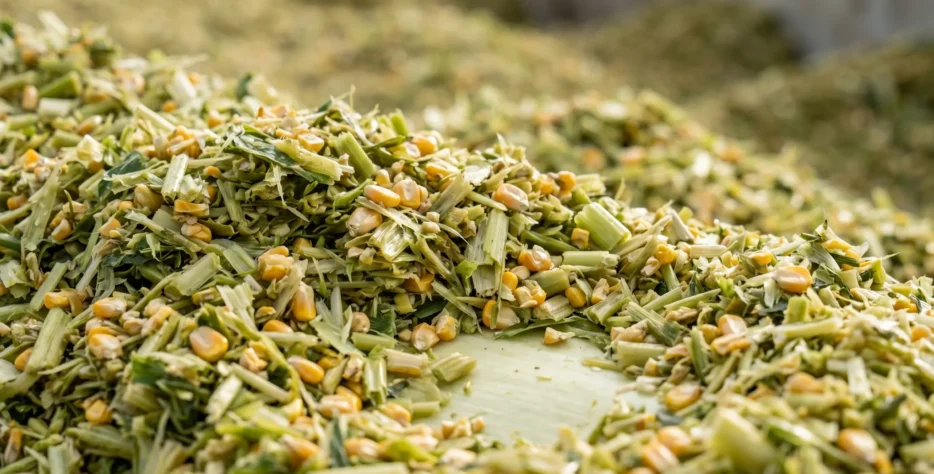
Corn Silage
Green Fodder That Actually Keeps Livestock Fed Year-Round
- Corn silage is whole maize — stalk, leaves, cobs — chopped at the right stage and fermented without air. The result is a high-energy feed that cattle digest well.
- It’s the standard feed for dairy cows, beef cattle, goats, and sheep when pasture dries up or fresh grass is hard to come by.
- Kiran Green Energy Solutions Private Limited does the full job — we grow the maize, turn it into silage, and deliver it ready to feed.
Benefits of Corn Silage
| Benefit | Description | |
|---|---|---|
| High nutritional value | Rich in energy, fiber, and starch; improves milk yield and animal health | |
| Year-round availability | Fermentation preserves fodder for 12+ months, eliminating seasonal shortages | |
| Reduced feed cost | Replaces expensive concentrates and imported feeds | |
| Better digestion | Fermentation breaks down fibers, increasing digestibility for ruminants | |
| Minimal wastage | Animals consume almost the entire plant (unlike dry hay) |
| Parameter | Value (Dry Matter Basis) |
|---|---|
| Dry matter content | 30–35% (at harvest) |
| Crude protein | 7–9% |
| Starch | 25–35% |
| Neutral Detergent Fiber (NDF) | 40–50% |
| Total Digestible Nutrients (TDN) | 65–72% |
| pH (after fermentation) | 3.8–4.2 |
How Kiran Green Energy Solutions Private Limited Helps
Porro quisquam est, qui dolorem ipsum quia dolor sit amet, consectetur, adipisci velit, sed quia non numquam eius modi tempora incidunt.
Organic Herbs and Produce for You
“From farm to feed bunk — we deliver corn silage you can count on, every month of the year.”
Our End-to-End Corn Silage Services
1. Committed Agricultural Farming and Mechanisation
- Large volumes of corn (maize) are produced using a fully mechanised planting system with precision planters and GPS for linear planting.
- Different types of plant varieties which are bred to be specifically used for coming from our silage program, offer maximum biomass yield, include high starch content, and have good resistance to the most common pest and disease problems.
- Corn is planted at a density designed to achieve the maximum number of tons per acre while still allowing for good crop stand establishment.
2. Well-Managed Irrigation System
- Advance irrigation systems that are designed specifically for use with Napier grass, and utilize scheduling based upon soil moisture sensors & timers.
- We use waste decomposers, organic NPK, and natural pest repellents—so we don’t have to keep buying expensive chemical fertilizers anymore
3. Regular Drone Survey (Crop Monitoring)
Crop Monitoring Parameters
| Parameter Monitored | Benefit |
|---|---|
| Crop health (NDVI) | Early detection of nutrient deficiency or disease |
| Biomass estimation | Predict yield per acre before harvest |
| Moisture stress mapping | Optimize irrigation timing |
| Harvest readiness | Pinpoint exact harvest window (30–35% dry matter) |
4. Optimized Manpower Utilization
- Crews include agronomists, machine operators, drone pilots, and silage technicians.
- Team size is calculated against acreage so nobody’s sitting idle and nobody’s overwhelmed
5. Proper Harvesting Schedule for Maximum Yield & Quality
Acre-Wise Harvest Planning
- Every acre gets GPS-tagged, soil-tested, and assigned its own ID.
- Planting is staggered so the harvest window runs 2–3 weeks rather than a single rush.
- We don’t harvest by the calendar. Timing is based on dry matter (30–35%) and where the kernel milk line sits (50–75%).
Factors Determining Harvest Timing
| Parameter | Target Range | Action |
|---|---|---|
| Whole plant dry matter | 30–35% | Harvest immediately |
| Kernel milk line | 50–75% | Optimal starch content |
| Plant moisture | 65–70% | Ideal for ensiling |
| Kernel denting | Just starting | Do not wait for full dent |
* Miss the window? Too early = low starch, too late = poor packing and spoilage.
6. Mechanized Harvesting
- Self-propelled forage harvesters with built-in kernel processors — cut and crush in one pass.
- Chop length is held at 1–2 cm. That’s short enough to pack tight but long enough for the rumen to work with.
- Every kernel gets cracked open so the animal actually absorbs the starch instead of passing it through whole
7. Transport & Rapid Delivery to Silage Pit
- Our own fleet of tipper trucks and forage wagons handles the haul.
- Chopped corn reaches the pit within 2–4 hours of cutting. That window matters — dry matter loss.
- Trucks are GPS-tracked so harvest and pit crews can coordinate without phone tag
8. Compacting & Ensiling (Fermentation)
Silage Preparation Process
| Step | Method |
|---|---|
| Packing | Layer-by-layer filling in bunker silos or bag silos |
| Compacting | Heavy tractors (10+ passes) to achieve density of 700–800 kg/m³ – removes oxygen |
| Sealing | Oxygen barrier film + UV-resistant tarpaulin |
| Fermentation | 45–60 days at pH 3.8–4.2 |
| Temperature monitoring | Weekly checks to prevent heating |
9. Strict Quality Parameters for Animal Feed
Our Silage Quality Standards
| Parameter | Our Standard |
|---|---|
| Dry matter at ensiling | 30–35% |
| Chop length | 1–2 cm |
| Kernel processing score | >70% (cracked kernels) |
| Fermentation pH | 3.8–4.2 |
| Mold or spoilage | Zero tolerance |
| Butyric acid | <0.1% (no undesirable fermentation) |
| Aerobic stability | >7 days after opening |
10. Year-Round Silage Availability
Acre-Wise Harvest Planning
- 12-month buffer stock stored in covered bunkers.
- Supply holds through monsoon, winter, and drought — no seasonal gaps
Available as: - Loose silage (for daily feeding straight off the pile)
- Baled silage (wrapped bales, easier to transport and stack)
Corn Silage vs. Napier Grass for Animal Feed
| Feature | Corn Silage | Napier Grass |
|---|---|---|
| Primary use | High-energy dairy feed | Maintenance / dry animal feed |
| Energy (TDN) | 65–72% | 50–55% |
| Crude protein | 7–9% | 8–12% |
| Starch content | 25–35% | <5% |
| Best for | Lactating cows, fattening | Heifers, dry cows, goats |
| Fermentation required | Yes (always) | Optional |
* Verdict: Corn silage for production animals; Napier grass for maintenance. Many farms use both for a balanced ration.
Why Partner with Kiran Green Energy Solutions Private Limited?
| Service | What We Deliver |
|---|---|
| Farming | End-to-end maize cultivation |
| Plantation | Highly mechanized, GPS-guided |
| Irrigation | Advance irrigation systems + drone moisture mapping |
| Drone survey | Regular (7–10 days) for health, biomass, harvest timing |
| Harvesting | Self-propelled forage harvesters with kernel processing |
| Transport | Dedicated fleet – pit delivery within 4 hours |
| Compacting | Heavy tractors – 700–800 kg/m³ density |
| Ensiling | Oxygen barrier film + pH monitoring |
| Quality | Strict parameters – no mold, correct DM, proper fermentation |
| Supply | 12-month year-round availability |
When an unknown printer took a galley of type and scrambled it to make a type specimen book. It has survived not only five centuries, but also the leap into electronic typesetting, remaining essentially unchanged.
Ideal For
- Dairy farms (cows, buffaloes)
- Cattle feedlots
- Goat and sheep farms
- Mixed livestock operations
- Silage traders and resellers
Quick Snapshot (Per Acre)
| Parameter | Value |
|---|---|
| Fresh yield per acre | 15–25 tons |
| Silage yield per acre (after fermentation loss) | 12–20 tons |
| Harvest frequency | 1–2 times per year (seasonal) |
| Days to harvest | 90–110 days after planting |
| Feeding per adult cow per day | 15–25 kg (fresh silage) |
Green fodder. Smart farming. Healthier animals. Higher yield.
Cart (0 items)
- Your cart is empty Browse Shop

